
Microsoft Secure Score is often misunderstood. Learn what it really measures in Microsoft 365, and why it matters for cybersecurity maturity, governance, and assurance.

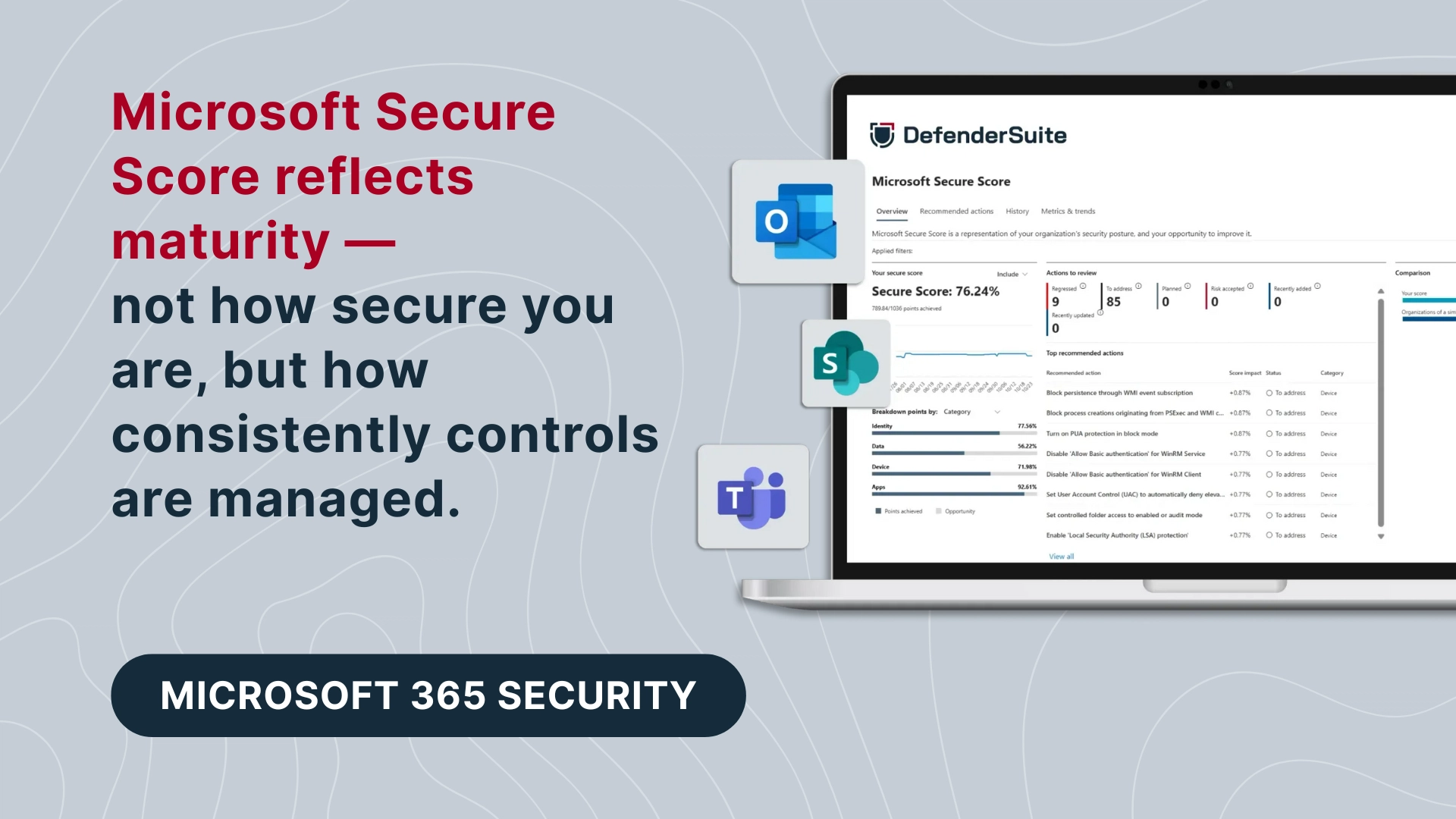
Microsoft Secure Score is easy to misinterpret.
For some, it becomes a number to maximise.
For others, it’s dismissed entirely as a Microsoft metric with little real-world value.
Both positions miss what Secure Score is actually useful for.
Secure Score isn’t a measure of whether a business is “secure”.
It reflects how consistently Microsoft 365 security controls are configured, applied, and maintained over time — which is why it’s most relevant in discussions about cybersecurity maturity, assurance, and governance rather than incident prevention.
That distinction matters when security needs to be explained, defended, or evidenced — not just implemented.
Microsoft Secure Score reflects how closely a Microsoft 365 environment aligns with Microsoft’s recommended security configurations.
Inside the Microsoft Defender portal, Secure Score shows:
Microsoft is explicit that Secure Score is designed to measure security posture and guide improvement, not to act as a guarantee of security. This is outlined directly in Microsoft’s own documentation.
By design, Secure Score does not assess threat activity, predict breaches, or replace broader cyber risk management. A higher score indicates stronger configuration alignment — not immunity from attack.
When used correctly, Secure Score provides something operationally valuable: visibility.
It helps show whether Microsoft 365 security configurations are:
From a cyber assurance and governance perspective, this trend-based visibility supports far more defensible oversight conversations than static reports or one-off audits.
Secure Score often loses credibility when it’s treated as a pass-or-fail benchmark.
Not every recommendation is appropriate for every business. Some controls may introduce operational friction, overlap with existing mitigations, or be addressed through alternative approaches outside Microsoft 365.
Microsoft acknowledges this by allowing Secure Score recommendations to be reviewed, deprioritised, or marked as risk accepted — reinforcing that Secure Score is intended to support informed decision-making, not blind compliance.
From a cybersecurity maturity perspective, what matters is whether decisions are deliberate, understood, and revisited — not whether every recommendation is applied.
On its own, Secure Score reflects Microsoft 365 configuration alignment.
Within a structured security and governance model, it becomes far more useful. Secure Score can support:
This aligns with how Microsoft positions Secure Score as one input into broader Microsoft 365 security management, not a standalone framework.
Without structure, Secure Score is just another dashboard.
With structure, it becomes a practical assurance signal.
Within DefenderSuite, Secure Score is treated as an input — not the outcome.
It is used to track Microsoft 365 security configuration alignment over time, inform prioritisation decisions, and support evidence-based assurance as part of a broader cybersecurity maturity and governance model.
Microsoft Secure Score does not secure a business by itself.
But when it is understood and used in context, it provides clear, defensible insight into whether Microsoft 365 security controls are being applied, reviewed, and maintained with intent.
The value isn’t the score.
It’s the visibility, context, and explainability the score supports over time.
If you’d like to discuss how Microsoft Secure Score can support cyber assurance and governance as part of a structured Microsoft 365 security approach, we’re happy to help.
Call us to get started: 1300 93 77 49
Email: info@defendersuite.com