
What the Defence Industry Security Program requires, who it applies to, and what businesses need to demonstrate to remain eligible for Defence work.

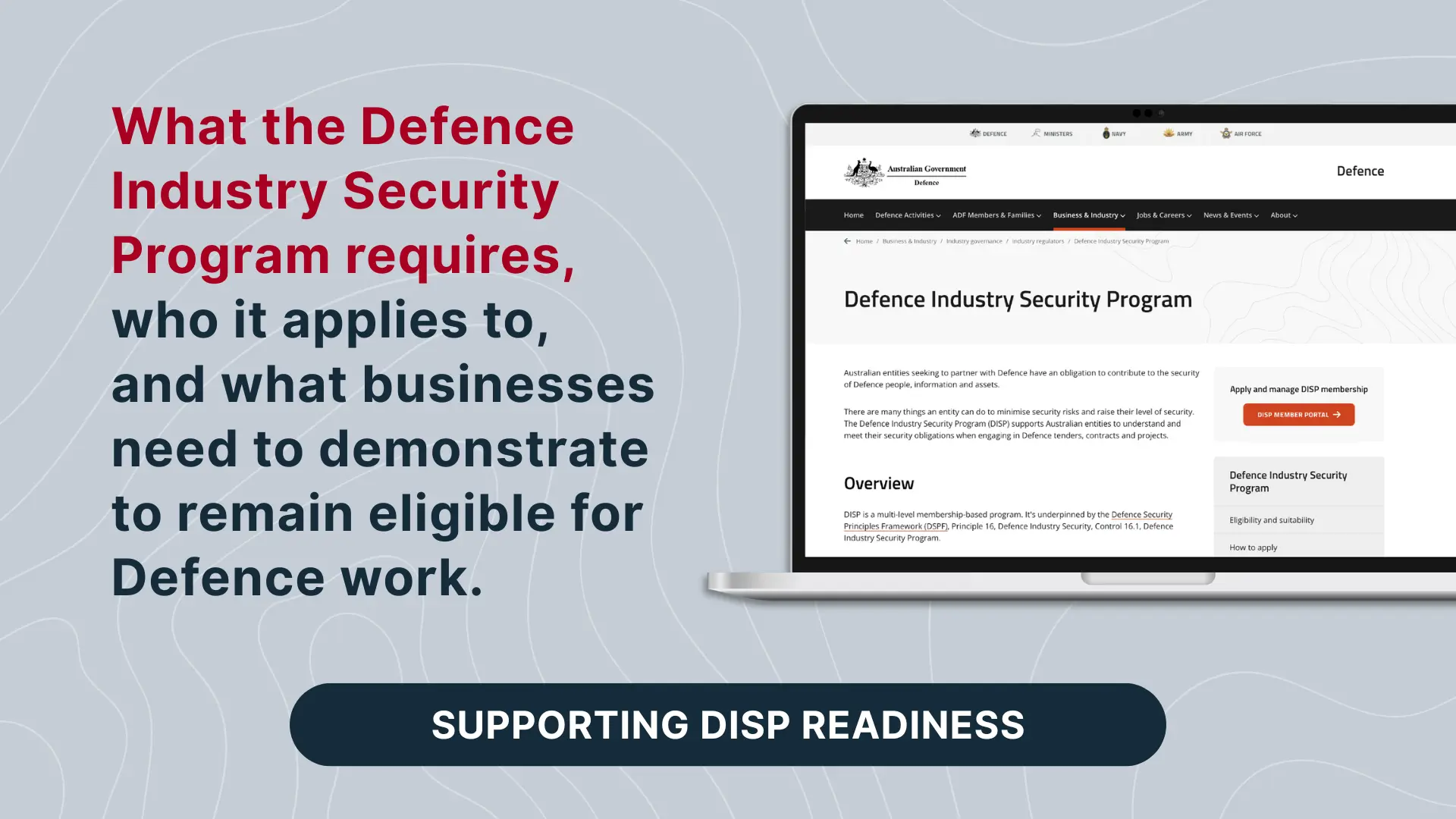
More Australian businesses are encountering the Defence Industry Security Program for the first time — not because they sought it out, but because a Defence prime, a government procurement process, or a contract renewal asked them about it.
For many, the question comes without much context. They understand they need to demonstrate something, but are unclear what the DISP actually is, what it requires, and whether their current security posture would satisfy it.
This article explains the DISP: what it is, what it expects of businesses, and how structured cybersecurity aligns with its requirements.
The Defence Industry Security Program is administered by the Australian Department of Defence. It establishes the security framework that businesses must meet in order to work on Defence projects — particularly those involving access to classified information, controlled technology, or sensitive Defence assets.
DISP membership is not a certification in the traditional sense. It is a formal relationship between a business and the Department of Defence, in which the business commits to managing security obligations across four key domains:
Membership is assessed by DISP assessors and, where relevant, requires demonstrated alignment with frameworks such as the Australian Signals Directorate's Information Security Manual (ISM) and the Essential Eight maturity model.
The DISP applies to any Australian entity that engages with Defence work where there is a security requirement. This typically includes:
A common misconception is that the DISP is only relevant to large, established defence primes. In practice, it increasingly applies to small and medium businesses that operate anywhere in a Defence supply chain — whether as a direct supplier, a sub-contractor, or a specialist service provider.
For these businesses, DISP membership is often not optional. It is a requirement for contract eligibility or renewal.
Defence procurement expectations have shifted considerably in recent years.
The Australian Government has placed greater emphasis on the security of the defence industrial base, reflecting the broader recognition that supply chain vulnerabilities represent a meaningful threat to national security. This has translated into more rigorous security requirements flowing down through Defence supply chains — including to businesses that may previously have operated without formal security obligations.
Two trends are driving the increased volume of DISP inquiries:
1. Supply chain security is being enforced more actively. Defence primes are increasingly required to ensure their sub-contractors and suppliers meet minimum security standards. Where this was once informal or inconsistently applied, it is becoming a standard contractual and due-diligence requirement. Businesses that previously fell below the threshold of scrutiny are now being asked to demonstrate their security posture.
2. Existing DISP members are facing more rigorous renewals. Businesses that have held DISP membership for several years are encountering more structured renewal processes, with greater emphasis on ongoing compliance, documented controls, and evidence of maturing security practices — rather than a one-time point-in-time assessment.
Both trends reflect the same underlying direction: security is treated as a continuous obligation, not an entry checkpoint.
DISP membership is structured around four domains, but the practical demands vary depending on the level of membership and the sensitivity of the work involved. There are four membership levels, ranging from baseline access to the highest-tier clearances for classified programs.
Across these levels, certain expectations are consistent.
Security governance must be formally established. This means a named Security Officer with clear responsibility, documented security policies, and evidence that security obligations are being managed deliberately rather than informally. For many SMBs, this is the first area of gap — controls may exist in practice but are not documented or accountable.
Personnel security must be actively managed. Staff with access to Defence-classified information require appropriate clearances, and the business must have processes to manage those clearances over time — including when staff change roles or leave.
Cyber security must reflect recognised frameworks. The DISP's cyber security expectations are aligned with ASD guidance, including the Essential Eight and the ISM. For most membership levels, businesses are expected to demonstrate meaningful progress against these frameworks — not merely awareness of them. This includes evidence of controls being in place, tested, and maintained.
Physical security must be appropriate to the work. This typically means controlled access to areas where classified information or sensitive Defence assets are handled, with appropriate documentation and oversight.
The weight of scrutiny across each domain increases with membership level and the sensitivity of the Defence work involved.
Of the four DISP domains, cyber security is the one that is most frequently underprepared — and the one where gaps are most likely to create problems during assessment or renewal.
This is not because businesses are unaware of cyber security. Most already have tooling in place: endpoint protection, email security, cloud-based storage and collaboration. The challenge is that the DISP's cyber security expectations go beyond the presence of tools. They require:
For businesses pursuing DISP membership or preparing for renewal, this means cyber security can no longer be treated as a background function. It needs to be a structured, governed, evidenced program.
This mirrors the direction of the broader regulatory environment — including the Cyber Security Act 2024, which formalises the expectation that cyber risk is managed at a leadership level, with documentation to support it.
The DISP does not define its own technical control framework from scratch. It draws on and references existing ASD guidance — primarily the Essential Eight and the ISM.
The Essential Eight provides a set of baseline mitigation strategies designed to protect against the most common and impactful cyber threats. It is structured around maturity levels — Level 1 through Level 3 — with each level representing a more consistent and complete application of the eight strategies.
The ISM provides a broader governance framework, defining how information security should be managed, reviewed, and maintained across an organisation's systems and operations. It applies particularly to businesses handling classified Defence information.
For most DISP-engaged businesses at the lower membership levels, Essential Eight Maturity Level 2 represents a reasonable working target for cyber security readiness. For higher-level membership — particularly where classified information is handled — ISM alignment becomes increasingly relevant, and the expectations for control depth and documentation are correspondingly higher.
What this means in practice is that DISP readiness and ASD framework alignment are not separate programs. Businesses that build genuine Essential Eight maturity are, at the same time, building the foundations that the DISP's cyber security domain requires.
Businesses that approach DISP readiness effectively tend to share certain characteristics. They treat it as a governance and operational program — not a documentation exercise completed shortly before an assessment.
In practical terms, this means:
Starting with an honest baseline assessment. Understanding where controls actually sit — across governance, personnel, physical, and cyber domains — before committing to membership or a renewal timeline. This avoids the situation of discovering significant gaps under time pressure.
Establishing clear ownership. Designating a Security Officer with genuine authority and accountability, and ensuring that security obligations are understood at a leadership level — not just by technical staff.
Building cyber security as an ongoing function. Implementing controls that align with the Essential Eight, maintaining them with regular patching and configuration reviews, and generating evidence over time — rather than reconstructing documentation at assessment time.
Treating documentation as a product of operations, not a parallel task. The strongest DISP applications and renewals are supported by evidence that reflects actual security practice: monitoring reports, incident logs, patching records, backup test results. These documents are a by-product of a well-run security program, not something assembled specifically for an assessor.
Planning for ongoing compliance, not a one-time event. DISP membership carries ongoing obligations — including Annual Security Reports and periodic assessments. Businesses that treat membership as a continuous operating discipline rather than a project manage renewals with significantly less disruption.
DefenderSuite is designed to help businesses build and maintain the structured, evidence-based security program that DISP readiness requires — rather than treating compliance as a separate activity from day-to-day operations.
In the context of DISP, DefenderSuite focuses on:
- Cyber security alignment with ASD frameworks. DefenderSuite maps controls to the Essential Eight and ISM, helping businesses demonstrate maturity against the frameworks the DISP references. This includes ongoing patching, endpoint protection, identity and access management, and managed detection and response — applied consistently and documented over time.
- Ongoing evidence generation. Monthly security reports, patching records, backup test results, and access control documentation are produced as part of standard DefenderSuite operations. This means DISP-relevant evidence is a continuous output of normal security practice, not a reconstruction exercise.
- Governance support. DefenderSuite helps organisations establish clear ownership of cyber security outcomes, with reporting structured to support leadership oversight and accountability — consistent with the governance expectations the DISP places on Security Officers and business leadership.
- Maturity progression over time. DISP expectations evolve with membership level and the sensitivity of Defence work. DefenderSuite is built to support maturity improvement across Essential Eight levels, allowing businesses to demonstrate ongoing uplift rather than static compliance.
DefenderSuite supports DISP readiness. It does not replace DISP assessors, formal membership processes, or the other domains — personnel, physical, and governance — that sit outside its scope. What it provides is the structured, maintained cyber security foundation that DISP-engaged businesses need to meet and sustain the program's cyber expectations.
For businesses working in or entering the Defence supply chain, DISP readiness is increasingly a commercial imperative as much as a compliance obligation.
Defence primes, government procurement teams, and enterprise customers in adjacent industries are scrutinising the security posture of their suppliers more rigorously than they once did. Businesses that can demonstrate structured, evidenced cyber security maturity — aligned with recognised ASD frameworks — are better positioned in procurement processes, contract renewals, and due diligence reviews.
The inverse is also true. Businesses that cannot clearly explain their security posture, or that lack the documentation to support their claims, face growing risk of exclusion from tenders, contract non-renewal, and reputational exposure if an incident occurs.
The DISP formalises expectations that are, in practice, already being applied informally across much of the Defence supply chain. For businesses that engage with Defence work, building a security program that meets DISP requirements is not just a compliance exercise — it is the foundation for sustained eligibility in an increasingly security-conscious procurement environment.
DefenderSuite – Defence Industry Security Program alignment overview
DefenderSuite – Cybersecurity for Defence Partners
Defence Industry Security Program (Department of Defence)
If your business is preparing for DISP membership, working through a renewal, or being asked to demonstrate cyber security maturity in a Defence context, we can help clarify what is required and how DefenderSuite supports structured alignment.
Call us to get started: 1300 93 77 49
Email: info@defendersuite.com