
What is SMB1001? Learn how this maturity-based cyber security standard is applied and how DefenderSuite aligns to its intent.

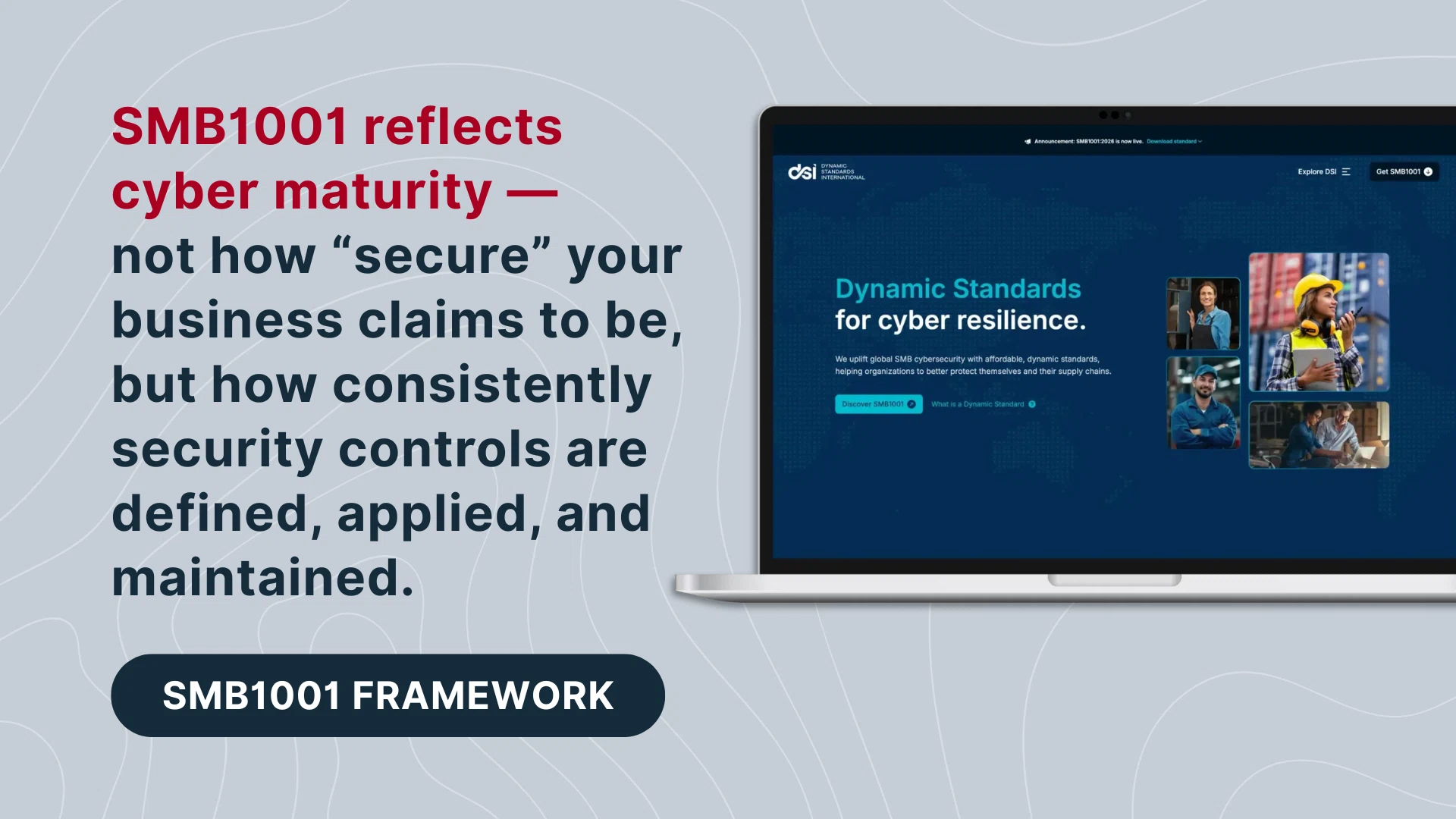
Cyber security expectations are becoming harder to ignore — but also harder to interpret.
Many businesses sit in the middle ground: too complex for informal or ad-hoc controls, yet not suited to heavyweight enterprise or government frameworks.
SMB1001 exists for this exact space.
Developed by Dynamic Standards International, SMB1001 is a tiered cyber security standard that provides a structured, achievable pathway for improving cyber maturity — without assuming large internal security teams or enterprise budgets.
This article explains what SMB1001 is, how organisations typically use it, and how DefenderSuite supports alignment with its intent.
SMB1001 is a maturity-based cyber security standard designed to be implemented progressively.
Rather than expecting businesses to meet an all-or-nothing benchmark, it defines:
In practice, SMB1001 is often used as a reference model — helping leadership and operations teams understand whether their current controls are reasonable, consistent, and sustainable.
SMB1001 is most often adopted by businesses that operate in assurance-driven environments — where cyber security needs to be explained clearly, applied consistently, and maintained over time.
This typically includes businesses that:
In practice, SMB1001 is frequently referenced across industries where trust, continuity, and governance are critical.
For example:
Across these sectors, SMB1001 is used as a way to introduce discipline and consistency into cyber security practices — without over-engineering controls or relying on informal, ad-hoc approaches.
SMB1001 is rarely treated as a single compliance exercise.
Instead, it’s used as:
For executives and ops leaders, the real value lies in clarity:
SMB1001 helps move those conversations away from assumptions and towards structure.
Depending on maturity level, SMB1001 introduces discipline across areas such as:
The emphasis is not on tools for their own sake, but on repeatable, maintained practices.
This is often where organisations struggle: controls may exist, but they are uneven, undocumented, or dependent on individuals rather than process.
DefenderSuite is designed to help businesses implement and maintain cyber security controls in line with SMB1001 expectations, rather than treating the standard as a theoretical reference.
Where SMB1001 defines what good practice looks like at different maturity levels, DefenderSuite focuses on how those practices are applied, operated, and sustained in day-to-day environments.
In practical terms, DefenderSuite helps organisations:
DefenderSuite is aligned with SMB1001.
It does not claim SMB1001 certification, and it does not replace formal assessment or certification pathways.
Instead, it provides the operational structure many organisations need to:
For organisations using SMB1001 as a reference point for cyber maturity, DefenderSuite acts as the execution layer — turning framework expectations into something that is actually run, maintained, and defensible.
Cyber security expectations rarely present themselves as a request to “adopt a framework”.
They surface through governance and risk pressure — often unexpectedly.
For many businesses, SMB1001 becomes relevant when:
In these moments, the challenge is not technology — it is explainability and consistency.
SMB1001 provides leadership teams with a recognised structure for making and defending cyber security decisions. It helps move conversations from assumptions to documented intent, defined ownership, and repeatable controls.
For operations teams, SMB1001 introduces operational discipline.
Controls are applied consistently, responsibilities are clearer, and security is managed as an ongoing function rather than a series of reactive fixes.
The practical outcome is reduced ambiguity:
That is why SMB1001 is often adopted not as a compliance exercise, but as a governance and operational baseline.
If your businesses needs a practical, maturity-based reference point for cyber security, SMB1001 is a sensible place to start.
DefenderSuite – SMB1001 alignment overview
SMB1001 standard (Dynamic Standards International)
If you’d like to discuss how SMB1001 can be used as a reference point for cyber security maturity — and how DefenderSuite supports structured alignment, governance, and assurance — we’re happy to help.
Call us to get started: 1300 93 77 49
Email: info@defendersuite.com